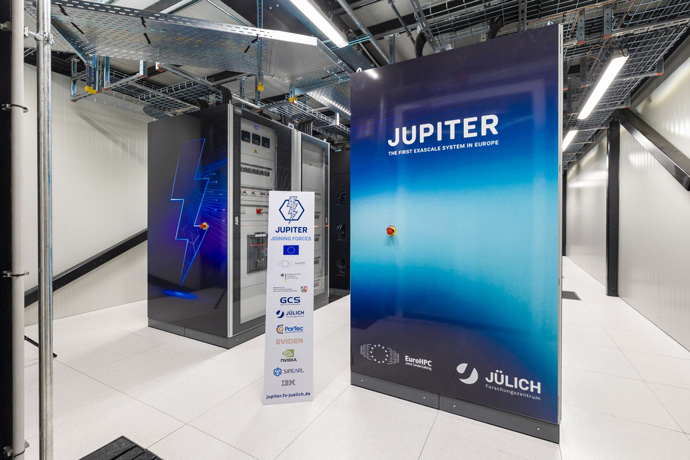
Numerical Weather Prediction (NWP)
Solving the equations of atmospheric motion at exascale, one grid point at a time.
Image: Forschungszentrum Jülich / Sascha Kreklau
From Physics Equations to Operational Forecasts
NWP solves the primitive equations of fluid dynamics and thermodynamics that govern the atmosphere, discretized across a global or regional grid. At kilometer-scale resolution, this produces billions of grid points that must be updated every few simulated minutes, all while a strict operational deadline looms: a forecast that finishes late is worthless. Malgukke's HPC architectures are built around this single constraint — sustained throughput within a fixed wall-clock budget.
HPC Solution Architecture: Observation to Forecast
A typical exascale NWP pipeline, as deployed by centers such as ECMWF on the JUPITER supercomputer:
Running on the TOP500: JUPITER
JUPITER — Forschungszentrum Jülich, Germany
JUPITER is Europe's first exascale supercomputer, ranked No. 5 on the June 2026 TOP500 list with 1.000 Exaflop/s sustained HPL performance. Built on Eviden's BullSequana XH3000 platform with NVIDIA GH200 Grace Hopper Superchips, JUPITER is hosted close to ECMWF's Bonn offices and used directly for numerical weather prediction: ECMWF has run its Integrated Forecasting System (IFS) and Artificial Intelligence Forecasting System (AIFS) on the machine as part of the "JEuExa" project, targeting global kilometer-scale forecasting.
Yes — this is a real, currently operating TOP500-ranked system, actively used for the workloads described on this page.
Voices from the Field
ECMWF researchers directly involved in bringing NWP workloads onto JUPITER:
Nils Wedi
Digital Technology Lead for Destination Earth, ECMWF
On running the first numerical weather prediction simulations with both IFS and AIFS on JUPITER.
Read articlePeter Düben
Head of Earth System Modelling, ECMWF
On why machines like JUPITER are essential to develop large machine learning models such as AIFS at scale.
Read article