Quantum Mechanics
From many-body system simulation to the architecture of next-generation quantum algorithms.
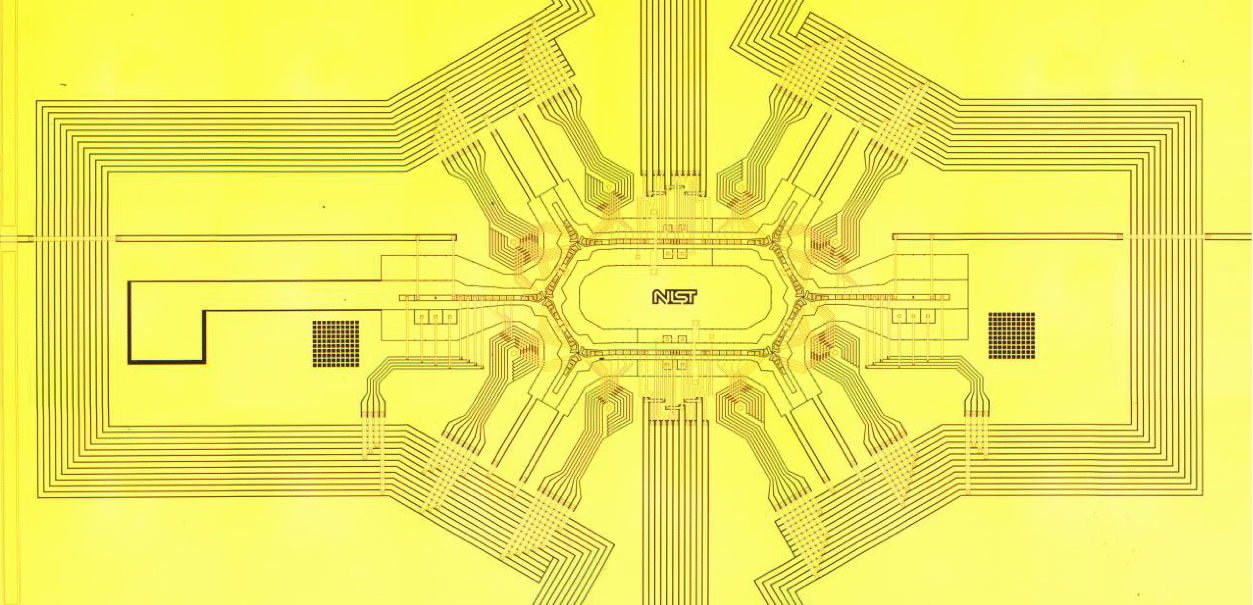
Image: J. Amini/NIST
Computing Beyond Classical Limits
Quantum mechanics research requires solving the Schrödinger equation for systems where complexity grows exponentially with every added particle. We provide the classical HPC backbone necessary to simulate these quantum states and verify the logic of the algorithms that will define the future of computing.
Many-Body Simulations
Modeling the collective behavior of interacting quantum particles. Essential for discovering new phases of matter and understanding high-temperature superconductivity.
- Density Functional Theory (DFT) at scale
- Quantum Monte Carlo (QMC) methods
Quantum Algorithm Development
Developing and benchmarking algorithms for NISQ (Noisy Intermediate-Scale Quantum) devices. Focusing on error mitigation and hybrid classical-quantum workflows.
- Variational Quantum Eigensolvers (VQE)
- QAOA (Quantum Approximate Optimization Algorithm)
Logic Layer: System -> Action -> Outcome
| Research Focus | HPC / GPU Action | Scientific Outcome |
|---|---|---|
| Material Science | Solving many-electron wavefunctions for $1000+$ atoms. | New Superconductor Discovery |
| Quantum Cryptography | Simulating Shor's algorithm benchmarks on classical clusters. | Post-Quantum Security Standards |
| Chemistry | Coupled Cluster calculations for complex enzyme catalysts. | Optimized Synthetic Processes |
How HPC and AI Power Quantum Research Today
Almost all industrially relevant quantum computing applications are hybrid: classical HPC systems handle the bulk of the computation, while quantum processors are called in for the specific sub-problems where they offer an advantage. Research centers such as Argonne National Laboratory and the Leibniz Supercomputing Centre are now building the software layers — schedulers, abstraction layers, hybrid workflow managers — that let quantum accelerators plug into existing supercomputing infrastructure much like a GPU does today.
AI plays a growing role on both sides of that pipeline: machine learning is used to discover new quantum algorithms and optimize error mitigation strategies, while quantum-inspired methods are beginning to feed back into classical HPC and AI workflows themselves.
Voices from the Field
Researchers working at the intersection of quantum computing, HPC, and AI share their insights in recent interviews:
Anita Schöbel & Pascal Halffmann
Fraunhofer ITWM, Kaiserslautern
On why nearly all industrially relevant quantum applications are hybrid, combining classical and quantum systems.
Read interviewLaura Schulz
Argonne National Laboratory
On building heterogeneous systems that combine CPUs, GPUs, AI, and quantum accelerators.
Watch interviewChristian Bauckhage
Fraunhofer IAIS
On the current state of quantum machine learning research and its practical relevance.
Watch interviewMiguel Marques
Ruhr University Bochum
On using AI-driven materials research to discover next-generation superconductors.
Read article