Aerospace & CFD
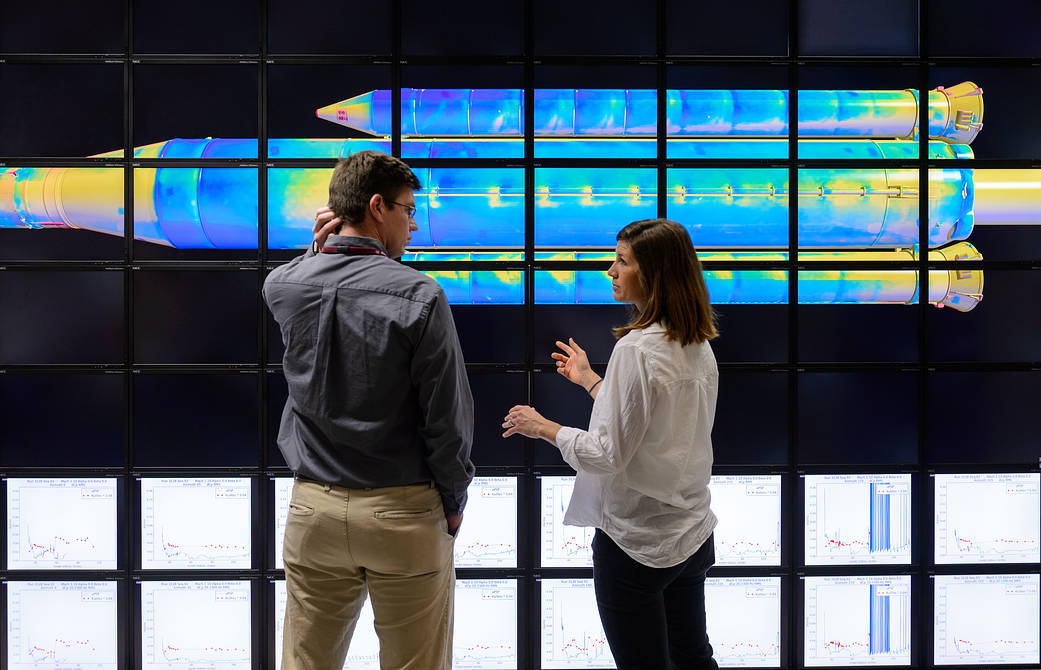
Turning a wind tunnel into a live data feed for a supercomputer, not just a photo op.
Image: NASA/Advanced Supercomputing Division/Dominic Hart
Resolving Turbulence at the Speed of Design
Aerospace CFD pushes Direct Numerical Simulation (DNS) and Large Eddy Simulation (LES) to their computational limits: resolving turbulent boundary layers at the millimeter scale over an aircraft that spans tens of meters. A single high-fidelity run can require billions of mesh cells and weeks of wall-clock time on a conventional cluster. Malgukke builds the GPU-dense, high-bandwidth-interconnect systems that compress that timeline, letting engineers iterate on wing and engine geometry in days rather than months.
HPC Solution Architecture: Geometry to Flight-Ready Design
A CFD pipeline comparable to workflows run on NASA's Pleiades/Aitken systems:
Running on the TOP500: Pleiades
Pleiades, operated by NASA's Advanced Supercomputing Division at Ames Research Center, was ranked No. 132 on the November 2023 TOP500 list with 5.95 petaflops sustained (7.09 petaflops peak) across 11,207 nodes. It is the same NASA Advanced Supercomputing facility that received the live-streamed wind tunnel data shown on this page — connecting physical Space Launch System testing directly to supercomputer-scale CFD analysis in real time.
Yes — this is a real, currently operating TOP500-ranked system, directly connected to the wind-tunnel-to-supercomputer workflow described on this page.
Voices from the Field
Dr. Heiko von Geyr
DLR Institute of Aerodynamics and Flow Technology, Braunschweig
On building a full digital twin of the ISTAR research aircraft to make virtual flight testing possible.
Read articleDaniel Silberhorn
DLR Institute of System Architectures in Aeronautics, Hamburg
On modeling how hydrogen, synthetic fuels, and hybrid-electric propulsion architectures reshape the aircraft of the future.
Read article