Engineering & Industry 4.0
Simulating the Physical World: Digital Twins and Atomic Material Science.
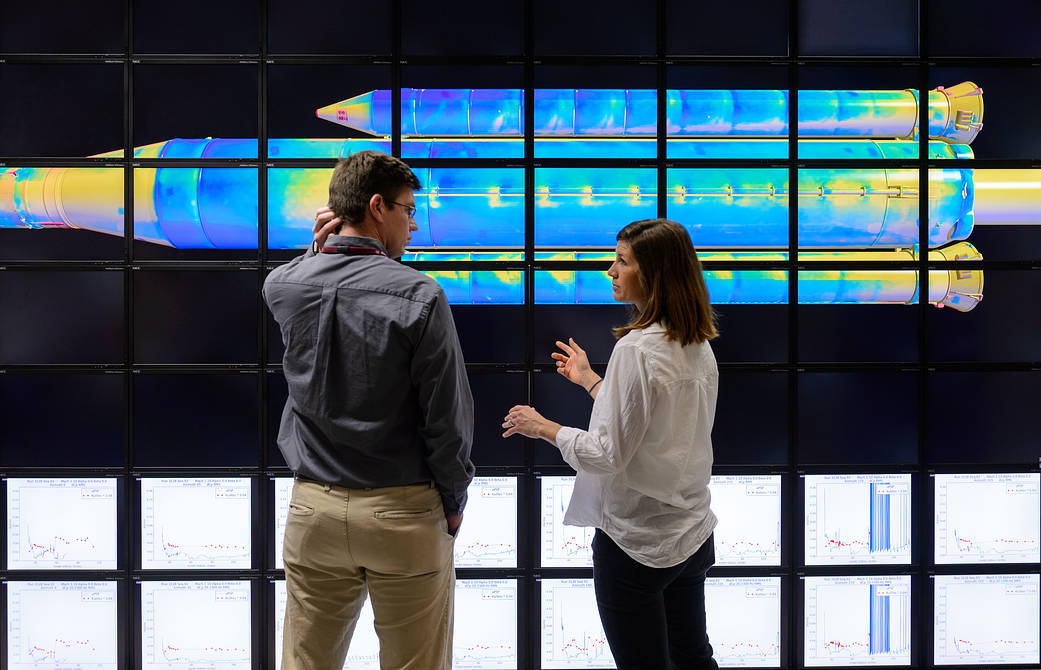
Image: NASA/Advanced Supercomputing Division/Dominic Hart
The Era of the Digital Twin
In modern industry, physical prototypes are becoming obsolete. Malgukke empowers engineers to build high-fidelity Digital Twins of aircraft, automotive systems, and energy grids. By leveraging massive compute power, we accelerate the R&D cycle from years to weeks.
Aerospace & CFD
Computational Fluid Dynamics: Optimizing wing geometry and engine combustion via DNS (Direct Numerical Simulation).
Structural Integrity: Simulating stress and heat distribution in hypersonic environments.
Automotive & Mobility
Crash-Test Simulation: Running multi-body dynamics to eliminate the need for physical destructive testing.
Autonomous Driving: Training AI perception models on synthetic sensor data from virtual environments.
Material Science
Atomic-Level Design: Modeling new superconductors and battery chemistries at the quantum level.
Polymer Modeling: Simulating molecular chains for high-strength, lightweight industrial materials.
Energy & Smart Grids
Renewable Optimization: Simulating wake effects in large-scale offshore wind farms.
Grid Management: AI-driven balancing of decentralized energy sources in smart-grid architectures.
Engineering Logic: Component -> Digital Action -> Industrial ROI
| Sector | Compute Action | Industrial ROI |
|---|---|---|
| Aviation | Processing 1B+ grid cells for virtual wind tunnel testing. | 15% Fuel Efficiency Gain |
| Manufacturing | Real-time Digital Twin synchronization via low-latency 5G/HPC links. | Zero Unplanned Downtime |
| Electronics | Quantum-mechanical simulation of semi-conductor electron flow. | Next-Gen Processor Node |
Global Pillars of Industrial HPC
Voices from the Field
Engineers and researchers working across digital twins and industrial HPC share their insights in recent interviews:
Dr. Heiko von Geyr
DLR Institute of Aerodynamics and Flow Technology, Braunschweig
On building a full digital twin of the ISTAR research aircraft to make virtual flight testing possible.
Read articleProf. Michael Resch
Director, HLRS High-Performance Computing Center Stuttgart
On why the fusion of HPC, AI, and sustainability is transforming supercomputing for industrial engineering.
Read article