Energy & Smart Grids
Simulating how a thousand wind turbines steal each other's wind, so the real farm doesn't have to find out the hard way.
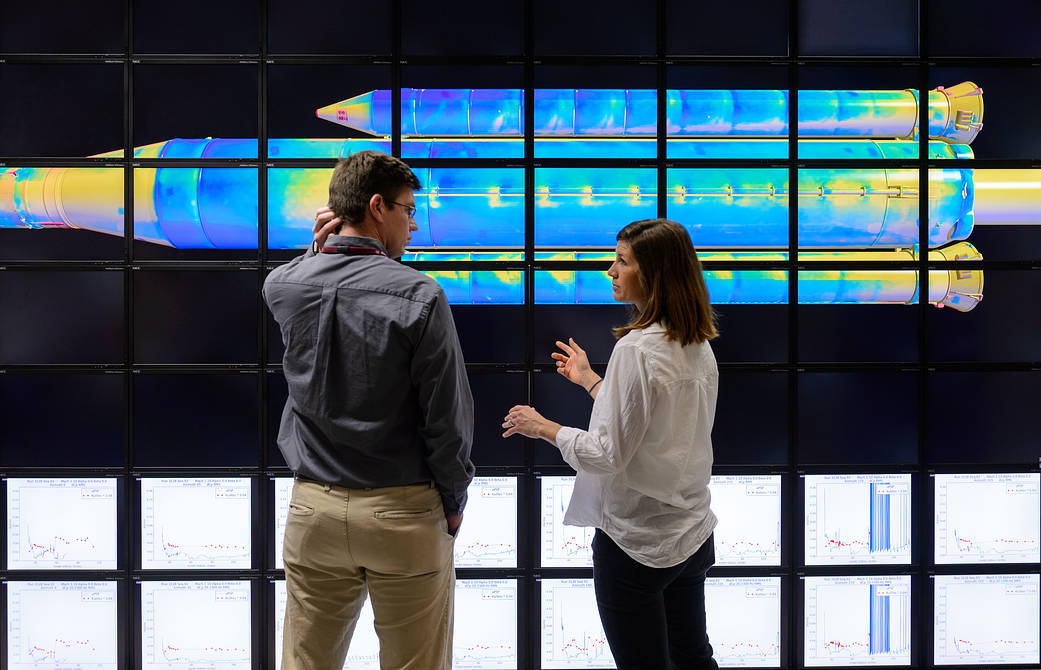
Image: NASA/Advanced Supercomputing Division/Dominic Hart
From Wake Effects to Grid Stability
Offshore wind farms lose significant output to wake interference between turbines — a CFD problem at the scale of an entire farm rather than a single blade. At the same time, integrating solar, wind, and storage into a stable grid means solving continuous optimization and AI-driven balancing problems across millions of distributed nodes, often in real time. Malgukke's heterogeneous CPU/GPU architectures are built to run both physics-based wake simulation and data-driven grid modeling side by side.
HPC Solution Architecture: Turbine Layout to Grid Balance
A renewable-energy simulation pipeline, comparable to workflows run on NREL's Kestrel system:
Running on the TOP500: Kestrel
Kestrel's CPU-only build phase debuted at No. 67 on the November 2023 TOP500 list at 14.3 petaflops; after full buildout with NVIDIA H100 GPU nodes in 2024, it reached 44 petaflops of combined performance. Operated by the National Renewable Energy Laboratory (NREL) for the DOE Office of Energy Efficiency and Renewable Energy, Kestrel is used directly for wind-farm wake simulation, solar-cell materials modeling, and grid-reliability research — the exact workloads described on this page.
Yes — this is a real, currently operating TOP500-ranked system, purpose-built by the U.S. Department of Energy for renewable-energy and grid research.
Voices from the Field
Kevin Lynn
Director of Grid Integration, U.S. Department of Energy
On touring NREL's Energy Systems Integration Facility to discuss how Kestrel's computing and visualization capabilities support grid research.
Read articleNREL Grid Modernization Program
National Renewable Energy Laboratory
On how student researchers used Kestrel's GPU nodes to model solar-wind effects on grid reliability and simulate protective coatings for nuclear reactors.
Read article