Automotive & Mobility
Crashing 45 million finite elements together, thousands of times, so no one has to crash a real car unnecessarily.
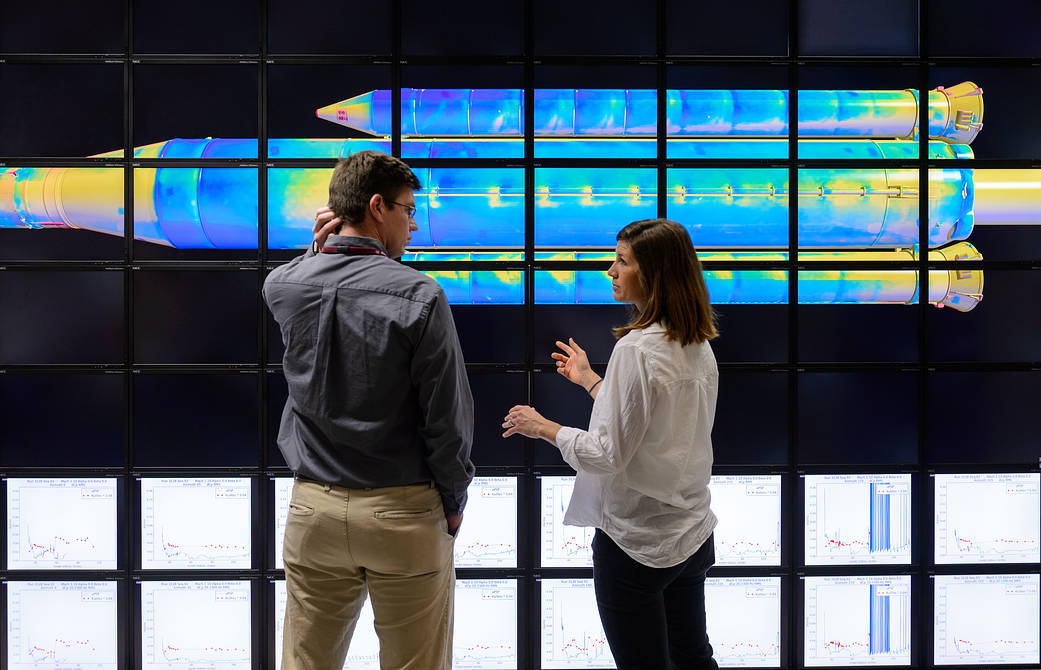
Image: NASA/Advanced Supercomputing Division/Dominic Hart
From Finite Elements to Certified Safety
Crash-test simulation tracks the physical stresses on tens of millions of finite elements across the milliseconds of a collision — a scale of detail comparable to real vehicle crash models. Combined with multi-body dynamics for suspension and autonomous-driving perception training on synthetic sensor data, automotive HPC workloads span structural mechanics, CFD, and AI in a single simulation pipeline. Malgukke builds the scalable simulation concepts that let manufacturers iterate designs digitally before a single physical prototype is built.
HPC Solution Architecture: Design to Crash Certification
A multi-physics automotive simulation pipeline, as run at HLRS for the Automotive Simulation Center Stuttgart:
Running on the TOP500: Hunter
Hunter is ranked No. 53 on the June 2025 TOP500 list with 48.1 petaflops of theoretical peak performance, built on AMD Instinct MI300A accelerated processing units at HLRS in Stuttgart. HLRS serves the Automotive Simulation Center Stuttgart (ASCS), a consortium founded in 2008 by Porsche, Daimler, Opel, and HLRS itself to develop next-generation crash, CFD, and structural-mechanics simulation software for the automotive industry — the exact workloads described on this page.
Yes — this is a real, currently operating TOP500-ranked system, directly used by German automakers and suppliers through the ASCS consortium for the automotive simulation workloads described here.
Voices from the Field
Prof. Michael Resch
Director, HLRS High-Performance Computing Center Stuttgart
On why the fusion of HPC, AI, and sustainability is transforming supercomputing for automotive and industrial engineering.
Read articleAutomotive Simulation Center Stuttgart
Joint industry-research consortium, HLRS
On 10 years of Porsche, Daimler, and HLRS collaboration developing simulation software that keeps pace with doubling core counts.
Read article