Fluid Dynamics & Thermohaline Flow
Modeling the ocean's conveyor belt before its tipping point arrives.
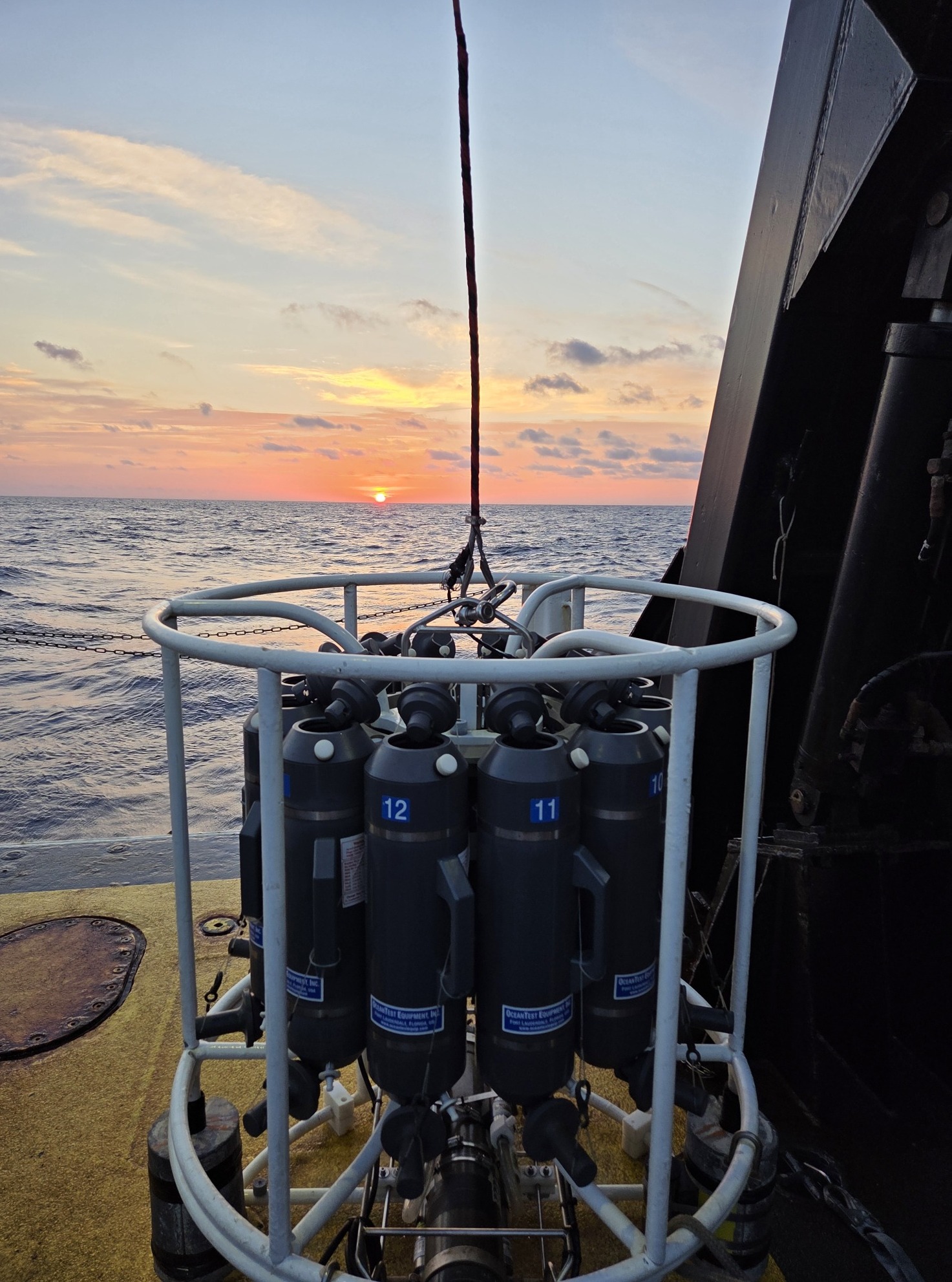
Image: Cassia Busch, USGS
Simulating the Atlantic's Conveyor Belt
The AMOC is not a single current but an emergent property of the entire Atlantic's density structure, driven by salinity and heat gradients that unfold over decades. Capturing its behavior — and the sub-mesoscale eddies that modulate it at 10 km scales — requires eddy-resolving CFD solvers running at petascale on a global ocean grid. Malgukke provides the CPU/GPU fabric and low-latency interconnect needed to couple these fine-scale ocean dynamics into century-length climate projections without the numerics drifting off course.
HPC Solution Architecture: Observation to Circulation Forecast
An eddy-resolving ocean circulation pipeline, comparable to GFDL's MOM6-based ocean models:
Running on the TOP500: Gaea
Gaea (C5/C6) — NOAA National Climate-Computing Research Center, Oak Ridge National Laboratory
Gaea is a pair of HPE Cray EX systems listed on TOP500.org's registry of supercomputing sites, with an aggregate peak capability exceeding 20 petaflops and over 150 petabytes of fast-access storage. Gaea's principal user is NOAA's Geophysical Fluid Dynamics Laboratory (GFDL), which develops and runs the MOM6 ocean model and coupled climate configurations such as CM4 and SPEAR — the exact ocean circulation workloads described on this page.
Yes — this is a real, currently operating system dedicated to ocean and climate research, directly used by GFDL for the circulation modeling described here.
Voices from the Field
Researchers tracking the state of the Atlantic's overturning circulation:
Stefan Rahmstorf
Potsdam Institute for Climate Impact Research (PIK)
On why the probability of an AMOC tipping point being reached this century is now estimated at over 50 percent.
Read articleWoods Hole Oceanographic Institution
Ocean in Motion research group
On the range of scientific views on whether — and when — the AMOC could undergo an abrupt transition this century.
Read article